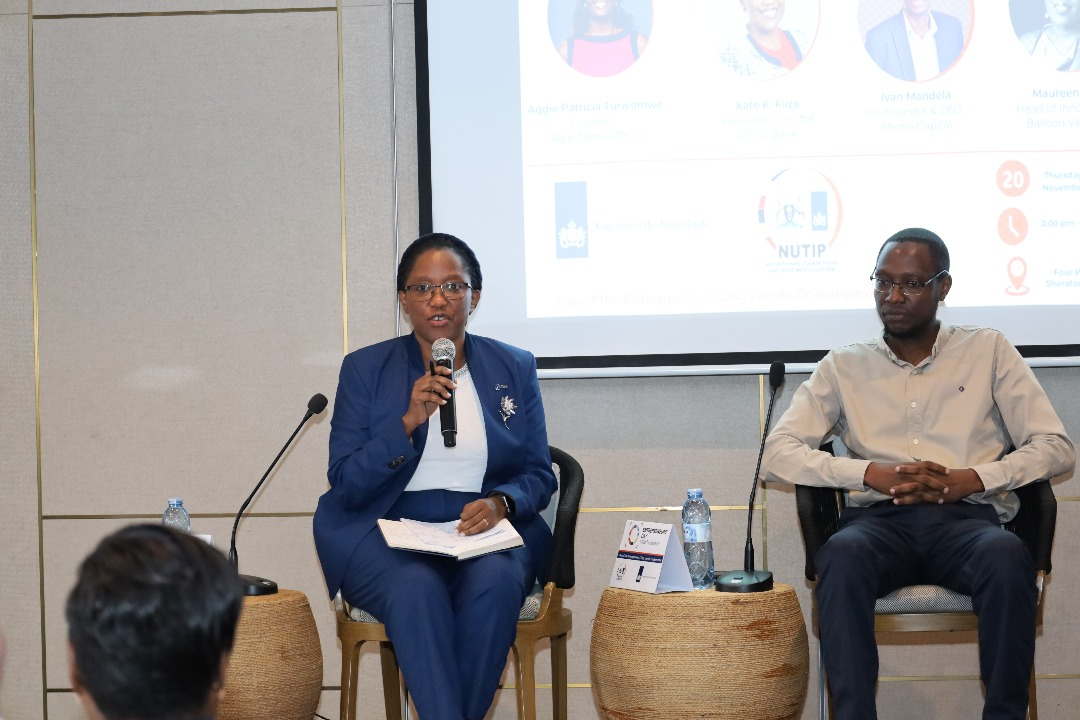
In a room filled with policymakers, investors, and entrepreneurs at Four Points by Sheraton in Kololo, Kate Kiiza leaned into a truth many founders carry quietly: in Uganda, building a business is rarely just about hustle. It is also about surviving the weather of the economy.
Kiiza, dfcu Bank’s executive director and chief corporate and institutional banking officer, was speaking at the Netherlands Uganda Trade & Investment Platform (NUTIP) forum during a panel titled “Scaling Through Support, Access to Finance and Services Ventures.”
The theme was technical, but her message was human. Entrepreneurship, she said, is a long road that needs systems to match the ambition of its people.
“Challenges are normal, and setbacks are never the end,” she told the audience, pushing back against a culture that often treats failure as a personal flaw.
Many of the headwinds entrepreneurs face – expensive credit, thin markets, volatile demand – are national problems, not individual weaknesses.
She pointed to a question that keeps resurfacing in boardrooms and trading centres alike: why do banks lend at about 15% while government borrows at around 17%?
For Kiiza, the answer is structural. Banks don’t price money in a vacuum; they operate inside the same macro-economy everyone else does.
That is why, she argued, partnerships with long-term financiers such as FMO and Rabobank matter.
They help plug gaps that local markets and public finance are not yet able to close.
Kiiza traced dfcu’s own decade of collaboration with the Embassy of the Netherlands and Dutch banking partners. Through programmes like the Best Farmer Competition, Financial Expansion for Agribusiness Transformation (FEAT), and the Business Accelerator Programme (BAP), dfcu has mobilised about $22 million toward farmer-centred interventions.
The impact, she noted, is visible in how farmers are modernising their methods, adopting irrigation, forming cooperatives, formalising their operations, and accessing financing at improved rates.
Platforms such as SOMA have added a softer but equally powerful layer, peer learning, digital confidence, and a sense that agriculture can be a business of pride, not just survival.
But Kiiza said scaling still breaks down at a simple point: records. Too many rural enterprises, she explained, run from memory, tally marks on walls, or scraps of paper.
Without credible accounts, a business cannot prove performance, plan growth, or qualify for capital.
dfcu’s response has been a step-by-step pre-investment readiness programme. Entrepreneurs are guided from manual counting to notebook tracking, to Excel, and eventually to full digital systems.
Each business receives a Business Development Manager, and later a Post-Investment Manager, supporting everything from operations and HR to governance and strategy.
Even collateral barriers, especially for women, are addressed through help with formal titling and alternatives such as spousal collateral.
She also reframed fundraising as a habit, not a hunt. “Capital lives in relationships, networks, and your ability to pitch your vision,” she said, urging founders to sharpen their selling skills, not only for products, but for the future they are building.
Kiiza described dfcu’s support pathway as a ladder: starting with dfcu Foundation for informal start-ups, moving into Enterprise Banking as records strengthen, then Medium Enterprise Banking for scaling firms, and finally Corporate Banking for mature businesses chasing bigger markets.
She added that dfcu is expanding into Iganga, Mbale, Lira, and Hoima to take this ladder closer to entrepreneurs outside the usual investment corridors.
Her closing point landed gently but firmly: Uganda’s SMEs don’t just need motivation.
They need a clearer runway, one built with patience, partnership, and systems that turn informal energy into investment-ready growth.