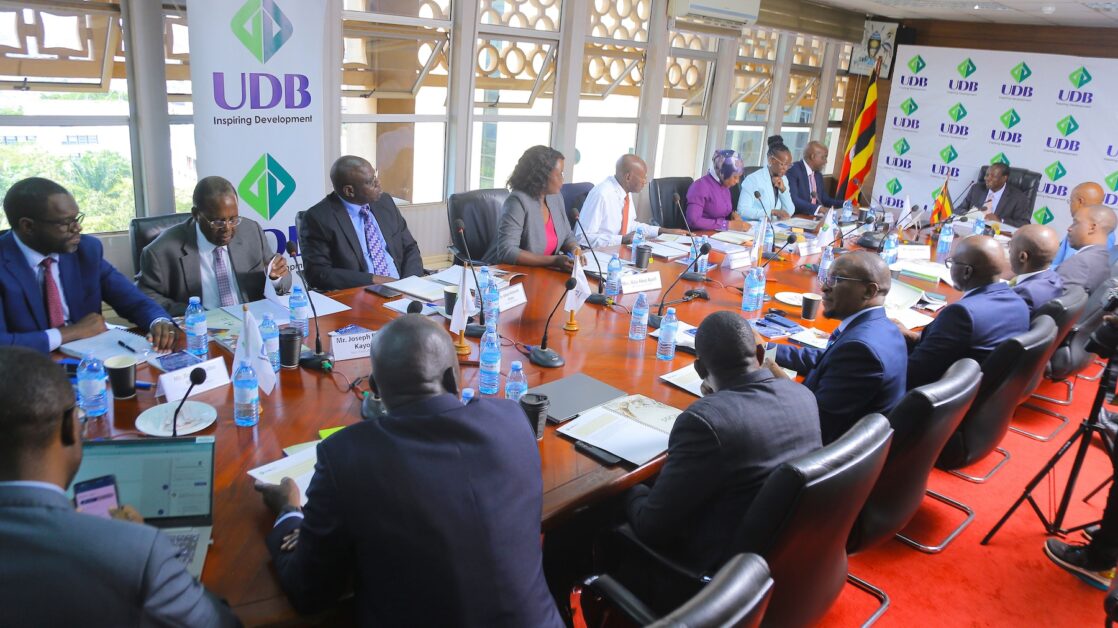
Uganda Development Bank Ltd (UDB), the country’s national Development Finance Institution has released its 2023 results, reporting what the bank says is a “continued pivotal role in fostering economic resilience and sustainable growth across key sectors of the economy”.
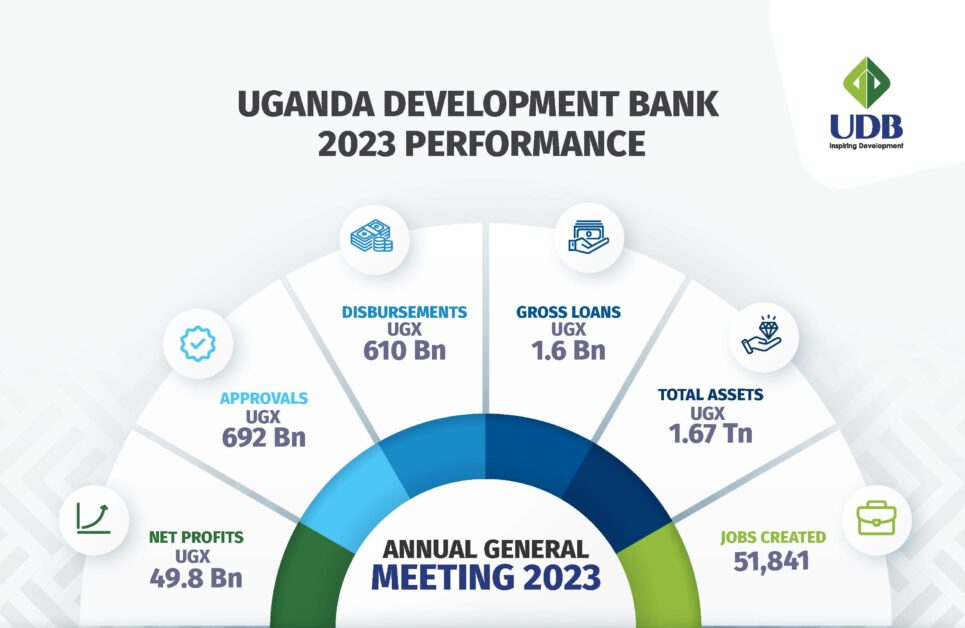
According to the results, released during the Annual General Meeting held at the Ministry of Finance, Planning, and Economic Development, the Bank continued to grow, with total assets closing at UGX1.67 trillion in 2023, a 10% uplift from UGX1.52 trillion the previous year.
This was largely boosted by growth in new loans⏤ new loans disbursed in 2023 amounted to UGX610 billion, increasing net loans growth by 20%, from UGX1.22 trillion in 2022 to UGX1.47 trillion in 2023.
Uganda Development Bank Limited (UDB) is the country’s national Development Finance Institution (DFI) with a mandate to accelerate socio-economic development through sustainable financial and non-financial interventions, both debt and equity. UDB also offers non-financial services geared at fostering enterprise investment readiness. Consistent with this mandate, the Bank supports projects within the private sector that demonstrate the potential to deliver high socio-economic value in terms of job creation, improved production output, tax contribution, and foreign exchange generation, among other outcomes. These projects fall within the key priority sectors of our economy and align with Uganda’s development priorities.
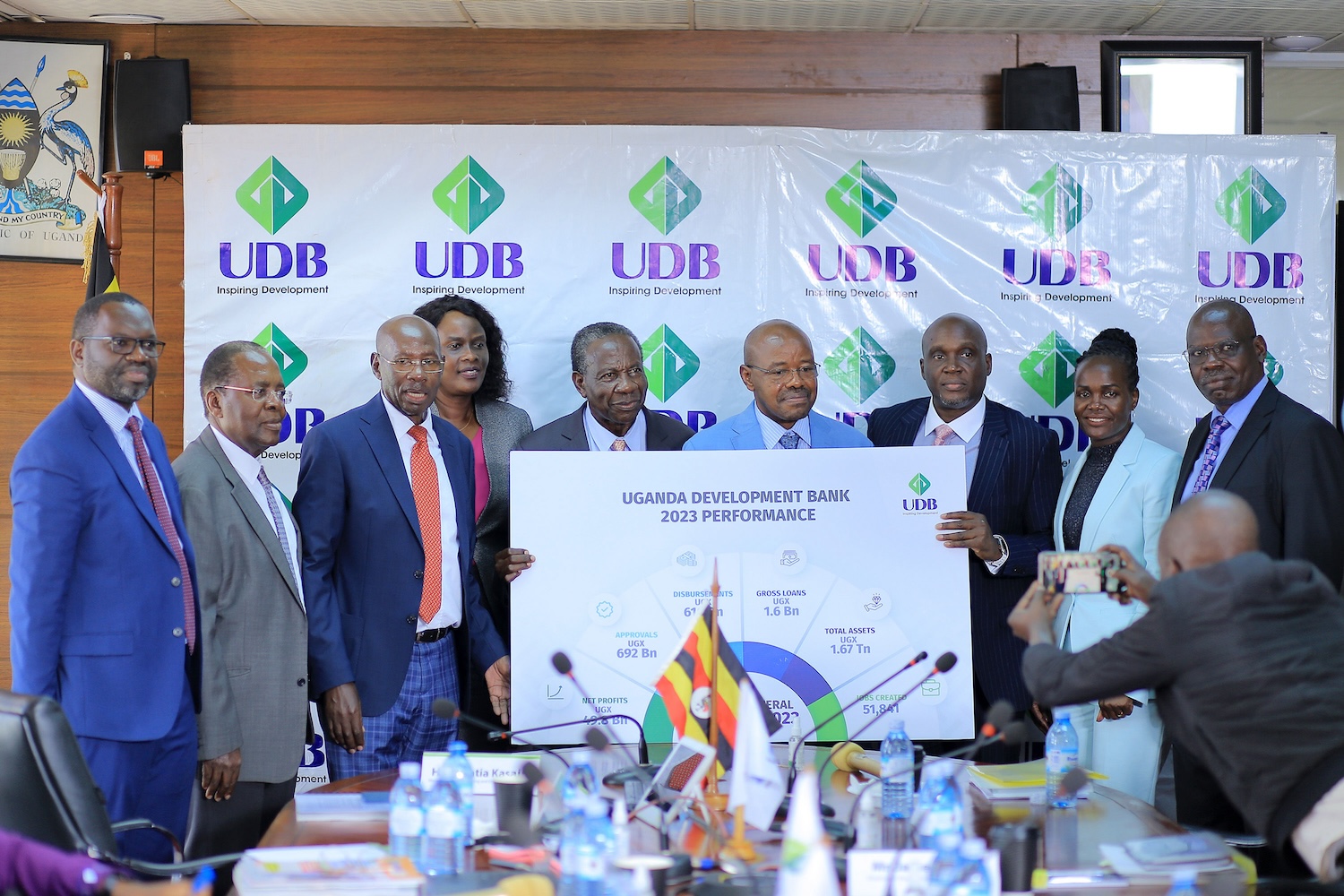
The AGM was attended by the Bank’s shareholders including among others, the Finance Minister, Hon. Matia Kasaija, and the Minister of State Planning, Hon. Amos Lugoloobi, who was appointed proxy to represent the Minister of State for Privatization and Investment, Hon. Evelyn Anite. Also in attendance were officials from the Office of the Auditor-General and the Ministry of Finance, the Bank’s Board of Directors, and Executive Management.
According to the UDB Managing Director Ms Patricia Ojangole, in 2023, the Bank approved UGX691.8 billion and disbursed UGX610 billion, demonstrating a dedicated approach to supporting private business growth.
“UDB remains committed to fostering inclusive economic growth through strategic investments in sectors that drive sustainable development and job creation across Uganda. Our focus on key priority sectors underpins our mission to deliver high socio-economic value and support Uganda’s long-term development goals,” she said.
Scaling Up Investment
In 2023, the Bank approved funding of UGX692 billion in new loans (UGX610 has been disbursed thus far) to over 200 enterprises in 63 districts nationwide.
“These projects, upon full implementation, are expected to create 18,558 new jobs and generate an output value of UGX11.4 trillion, from which UGX616 billion will be generated as tax revenue to the Government, and UGX3.34 trillion in foreign exchange earnings,” the Bank’s Annual Report reads in part.
Additionally, the Bank implemented various institutional initiatives to expand its support to various vital sectors and address systemic growth constraints in the economy, including the following:
- Access to Clean Water: Through a multi-stakeholder partnership, the Bank extended UGX27 billion in funding to enhance water supply and improve water infrastructure, especially in scarcity-prone areas; under the program, up to 774 Kms in new water mains extension was realized, 27,307 new water connections realized, and 1,619 new public standpipes constructed to cater for 858 villages across the country.
- Access to Electricity: Through a multi-stakeholder partnership, UGX8.1 billion was deployed through the Hybrid Electricity Customer Connection Credit Framework, facilitating 38,833 new connections to the electricity grid nationwide.
- Supporting Local Content: The Bank launched a UGX150 billion funding allocation to support Ugandan contractors participating in infrastructure projects, a testament to our belief in the potential of local businesses.
- Serving the underserved segments: Under its Special Programs proposition, the Bank continued to focus on expanding its support to the Youth, Women, and SME segments – with an additional allocation (approval) of UGX21.2 billion in 2023 and disbursement of an additional UGX13 billion to support various enterprises across the country, demonstrating our commitment to inclusivity and equality.
To enhance business resilience and formalization, through its Business Accelerator for Successful Entrepreneurship (BASE), the Bank provided business development and coaching programs to 450 enterprises nationwide, of which 291 were identified to undergo business incubation in 2024. The program also supported 24 farmer groups, consisting of 444 households and 330 women-led enterprises. This support is aimed at empowering and fostering the growth of these businesses.
Expanding reach and creating a sustainable impact for Ugandans
The bank began operationalizing its regional representative offices to expand its reach, opening the inaugural regional office in Gulu in 2023. Plans are underway to open four more offices—in Mbale, Hoima, Mbarara, and Arua by mid-2025.
The Bank is also optimizing technology to enhance access to finance. In 2023, in collaboration with partners including UNCDF, FAO, and Ensibuuko (a FinTech), the Bank launched the UDB AgriConnect. This novel digital lending solution facilitates smallholder farmers arranged in Village Saving and Loans Associations (VSLAs) in rural Uganda to access finance from the Bank. Under the initiative, smallholder farmers save and access micro-loans to support essential production activities, including purchasing seeds and other key farm inputs.
The bank’s interventions either created and or maintained 51,841 jobs amongst the financed enterprises, compared to 51,439 jobs realized in 2022.
“64% of the jobs created and maintained were filled by the youth, 27% by women, and 0.25% by Persons With Disabilities (PWDs). Additionally, 33%, 39%, and 0.2% of the youth, women, and PWDs, respectively, are among the shareholders,’ the report reads.
The output value from funded enterprises grew by 71% year-on-year, from UGX3.4 trillion in 2022 to UGX5.8 trillion in 2023, supported by improved production mainly in agriculture and industry.
 #WomenFixingUganda: Q&A with Leadership Coach Eileen Walusimbi on Conscious Leadership That Builds Lasting Organisations
The profitability of the funded enterprises improved to UGX869 billion, up from UGX492 billion in 2022.
“Because of improved output, performance, and profitability amongst the companies financed by the Bank, their total contribution to government tax revenue grew by 60%, to Ugx236.1 billion from the Ugx147.5 billion registered in 2022,” a statement from the bank said.
Conversely, the earnings from locally produced destined products (exports) improved by 47% from UGX649 billion to UGX953 billion because of increased production, particularly in the manufacturing and agro-processing sectors.
Notably, up to 66% of all raw materials utilized in enterprises funded by the Bank were locally produced during the year.
“Prioritizing social inclusion in the Bank’s development agenda is fundamental in fostering a resilient, inclusive, and sustainable society where no one is left behind. To the Bank, social inclusion symbolizes diversity and social cohesion, unlocking the full potential of individuals and societal segments where everyone can fully participate, contribute, and thrive,” reiterated Ms Ojangole.
Financial Performance
In 2023, the Bank realized a post-tax (net) profit of UGX 49.8 billion, a 17% uplift from UGX 42.6 billion registered in 2022. This resulted from the sustained growth in the Bank’s balance sheet, matched by prudent investment in interest-earning assets while ensuring lean operations.
To fund the creation of these assets, the Bank reinvested UGX467 billion it collected as repayments from its borrowing customers and deployed UGX97.3 billion received from the Government as additional capital contributions, complemented by an additional UGX120.5 billion in drawdowns from various lines of credit held with its funding partners.
The bank also reported that it was running lean and efficient operations as manifested by a cost-to-income ratio of 30.6% a return on asset ratio of 3.12% and a return on equity of 3.82%.
During 2023, the bank also received various local and international recognitions. For example, for three consecutive years, the Bank and its Managing Director emerged the Sustainability Leader of the Year at the Karlsruhe Sustainability Awards in Germany, to recognize the MD’s exceptional leadership in driving the business performance of UDBL through creating social, economic, and environmental values and globally advancing sustainable finance.

UDB also secured a ‘AAA (Uga)’ National Long-term Rating with a Stable Outlook, the highest rating on Uganda’s national scale. This designation, assigned by Fitch Ratings, a globally renowned credit rating agency, was accompanied by a ‘B+’ Long-Term Issuer Default Rating (IDR) with a negative outlook – the same pegged to Uganda’s Sovereign rating, reflecting the Bank’s ownership by the Government. These ratings lend credence to the Bank’s operations and governance and bolster its borrowing initiatives.
UDB also achieved an A+ rating from the Association of African Development Finance Institutions (AADFI), affirming its leading status as a best-performing Development Finance Institution (DFI) in Africa. This recognition is awarded to AADFI member-DFIs demonstrating excellence in compliance with various prudential standards, particularly in governance, operational efficiency, and financial and institutional performance.
The Minister of Finance, Planning, and Economic Development, Hon. Matia Kasaija, lauded the Bank for its exceptional contribution towards the realization of the Country’s National Development Plan III and Vision 2024.
“The Government has played a pivotal role in significantly contributing to the country’s socio-economic transformation. In 2024 and beyond, the focus will be on mobilizing adequate resources to enable UDB to continue to deliver its mandate. The Bank will also undertake the implementation aiming to accelerate productivity, import replacement, and export promotion. Additionally, the Bank will advance its holistic sustainability agenda and deepen financial inclusion for SMEs, women, and youth,” he said.
In his conclusion, the Chairman of the Board of Directors Uganda Development Bank, Mr Felix Okoboi, pledged the Bank’s continued commitment towards catalyzing socio-economic development within the country.
“UDB remains resolute to driving inclusive economic growth through innovative financing solutions and leveraging strategic partnerships, reinforcing its role as a catalyst for sustainable development in Uganda,” Mr Okoboi said.