In a recent exclusive interview with the CEO East Africa Magazine’s Muhereza Kyamutetera, Mafabi distills a decade of hard-won experience into eight powerful lessons that every business leader, whether in finance, tech, or any other sector, should take to heart. His message is clear: leadership is not a title; it’s a responsibility to act, to empower, and to stay relentlessly focused on what matters most—delivering results and building a legacy.
Self-Discovery: The Foundation of Authentic Leadership
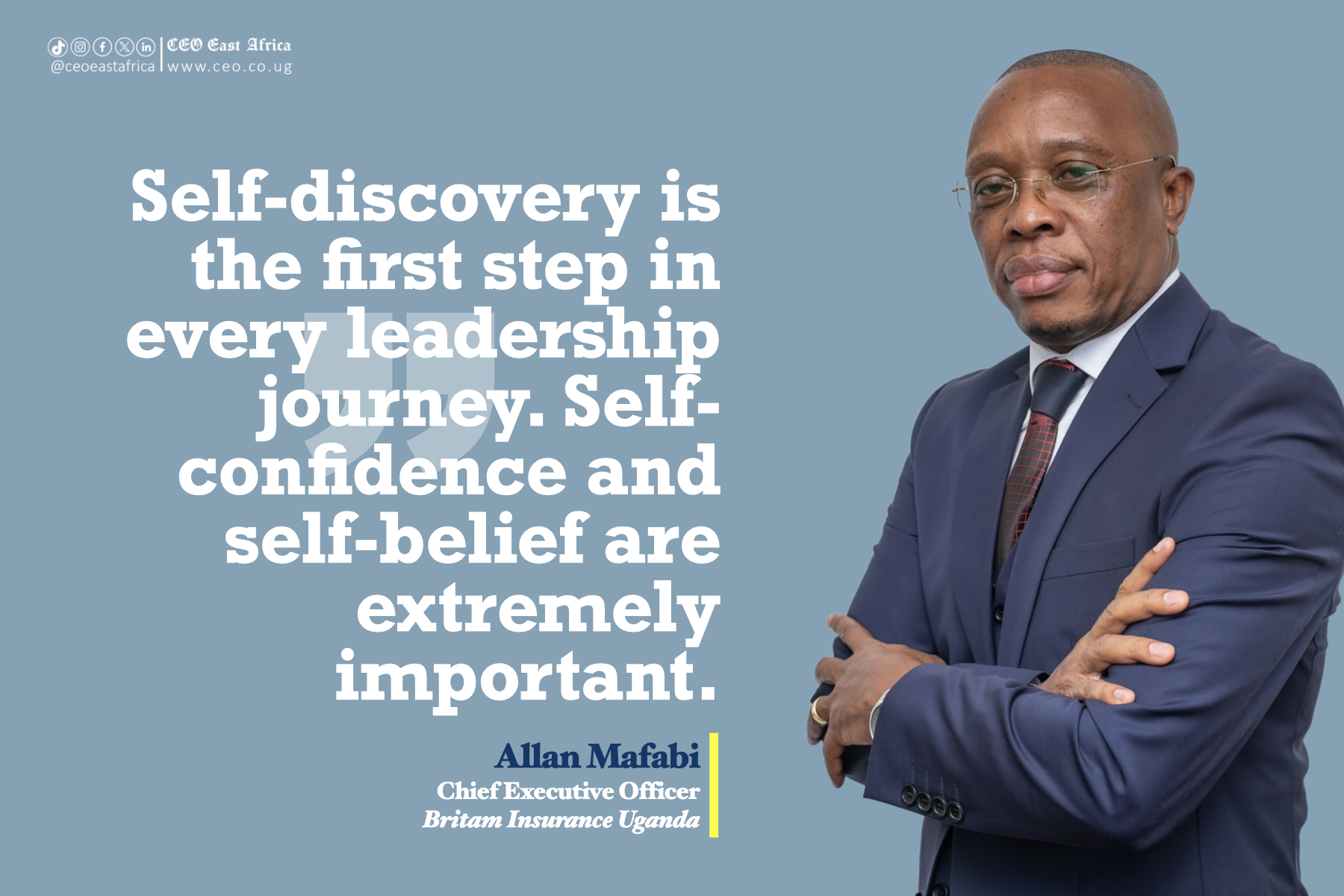
True leadership begins with looking inward. For Allan Mafabi, self-awareness is non-negotiable. “Self-discovery is the first step in every leadership journey,” he asserts, emphasizing that before a leader can guide others, they must first understand themselves—strengths, weaknesses, blind spots, and all. This clarity builds confidence: “Self-confidence and self-belief are extremely important. I tell that to all the upcoming leaders that I meet.”
But self-discovery is not a one-time event—it’s an ongoing commitment to learning, unlearning, and relearning. As Mafabi advises, “learn, read, unlearn and relearn. The more you know the subject you’re talking about, the more comfortable and confident you are about yourself around people and that is a key leadership trait and an inspiration to others who look up to you.”
For Mafabi, this self-awareness is the compass that guides decision-making, sharpens vision, and empowers leaders to inspire confidence in their teams.
Transformational Leadership is a Blend, Not a Template
Leadership, as Allan Mafabi sees it, is not a one-size-fits-all formula. “There is no mutually exclusive type of leadership,” he says. Instead, true leadership is a fluid, adaptive process—“always a blend, depending on where you are and the circumstances.” It’s the ability to read the room, adjust your approach, and inspire people to rise to challenges they never thought possible.
For Mafabi, transformational leadership is about driving change by example: “I’ve transformed this company. I’ve transformed several people and with a proven track record.” It’s about vision, courage, and the unrelenting pursuit of excellence, where strategy and action meet.
Execution is the Ultimate Differentiator
In business, it’s not enough to have strategy or a great idea—it’s the ability to deliver that sets leaders apart. As Allan Mafabi puts it, “Every company has a strategy, but what separates them is execution.” He draws inspiration from the razor-sharp precision of Formula 1 teams, where even the smallest mistake can make or break a race. “Imagine how 20 or so people work seamlessly together to change all 4 tyres on a car in under 2.5 Seconds (the record is actually 1.8 secs)—the height of precision and the true meaning of teamwork.”
For Mafabi, execution is a mindset—one where delays are unacceptable, and every team member understands the urgency of their role. “If it is a bid document we are working on, that’s the kind of precision mindset and teamwork that I expect.” This relentless focus on action has been the driving force behind Britam’s transformation from a loss-making company to a market leader.
Build a Culture of Precision and Discipline
Mafabi’s 5am Club is not a gimmick—it’s a deliberate, disciplined approach to leadership and life. “Waking up an hour earlier means you control both your early mornings, which are the most productive, and also your evenings. That’s why I am in the office at 06 am and many of my Team members have followed suit and I thank them for taking up the challenge.”

For Mafabi, precision starts with personal discipline and extends to the team. He is clear: “Once you get your team, for those who have an opportunity to build their own teams, nurture them—I don’t really believe in getting people from competition—build your own and insert in them what you want to see. I call them your special gears.”
By embedding these habits into Britam’s DNA, Mafabi has built a culture of accountability, speed, and high-performance—where every team member understands their role in the pursuit of excellence.
Pay Your Claims—Promptly and With a Smile
According to Mafabi, the true measure of an insurance company is not in its slogans, but in its actions—especially when it comes to paying claims. “What are we as an insurance company if we are not paying our claims promptly?” he asks, framing it as both a moral obligation and a competitive edge.
At Britam, claims service isn’t just a process—it’s a philosophy. “My people know—that a good insurance company pays its claims on time and with a smile.” It’s this relentless commitment to delivering on promises that has fueled Britam’s growth and earned the trust of brokers, banks, and clients alike.
 Why we are all vital to Uganda's Development.
His approach is results-driven: “For the small claims, my target is 24 hours. We are succeeding in that for some and for others we are failing because of other challenges like technology/connectivity. Right now, we have come from one week to 5 days, then 3 days and we are now at about 2 days.”
The goal is simple: speed, trust, and service—because in insurance, as Mafabi reminds his team, “If you don’t pay claims, you don’t have a business.”
Be a Visionary—Anticipate and Lead Change
Mafabi is clear: leadership is about seeing beyond the horizon and daring to act first. “If you are to transform the industry, you have to lead by example and to do that, you need to take some tough and often difficult decisions that seem to go against logic.” His bold moves, from pioneering the cash and carry model to advocating for local marine insurance, have reshaped Uganda’s insurance sector.
Yet, Mafabi is not complacent. The spectre of disruption is never far from his mind: “This industry is very vulnerable to serious disruption. To be honest with you, you know, the disruption by digital, by AI is quite unprecedented and gonna eat up quite a number of companies.” His message is clear—leaders must stay ahead of change or risk being overtaken by it.
To him, vision is more than foresight—it’s the courage to take risks, the humility to learn, and the drive to innovate before necessity demands it.
Local Knowledge is a Competitive Advantage
Mafabi believes, the power of local knowledge is indisputable. “Local knowledge is very important because it improves your capacity to appreciate the entire business landscape, and the Ugandan business nuances and to be able to understand them fully to see the bigger picture.” It’s this intimate understanding of the market, its challenges, and its potential that has guided Britam’s rise under his leadership.
He is proud of the shift he has championed: “When I got this job they said, you’re going to make it or kill it for the other young aspiring Ugandan CEOs in the industry.” His success opened doors for others, challenging the outdated perception that only foreign CEOs could lead effectively in Uganda.
Today, he celebrates the growing cadre of local leaders transforming the industry: “Right now there are many young CEOs out there and they are Ugandans, almost the entire industry, and I’m ever so proud.” It’s a revolution he believes is long overdue—and one he’s determined to sustain.
Build a Legacy Through People
Mafabi’s proudest achievement? It’s not the billions in premium income or the market rankings—it’s the leaders he has nurtured along the way. “One of the things I want in my legacy is how many leaders have I built in the industry.” For him, leadership is not a title or a personal accomplishment—it’s a responsibility to multiply impact by empowering others to lead.
This commitment runs deep in the way Mafabi builds his team. He believes in creating an environment where people are trusted to think, act, and make decisions—where leadership is not centralised, but distributed. As he reflects, “Whenever I talk to them, they are glad I had an impact on them in their professional transformation and leadership and that is very humbling.”
Mafabi’s leadership philosophy is clear: build your own team, shape them with the right mindset, and challenge them to do the impossible. “Once you get your team, for those who have an opportunity to build their own teams, nurture them—I don’t really believe in getting people from competition—build your own and insert in them what you want to see. I call them your special gears.”
He sees leadership as a long game—an investment in the future of the industry. “I’ll consider myself as having not done enough if I do not train enough people who can continue running these companies when we are gone such that they do not have to bring foreigners to save the day like it was, back then.”
As Allan Mafabi charts Britam’s next chapter—launching a life insurance arm, venturing into agro-insurance, and deepening digitisation—his leadership blueprint is clear: know yourself, build your team, execute with precision, and always stay ahead of the curve. It’s a story of resilience, vision, and staying in the fast lane—without losing your sanity. Or as Mafabi puts it, “It is a Team Game.” And in that game, the only way to win is to lead from the front.