The agreement establishing Africa as one trading block came into force in 2019, setting January 1, 2021 as the date trading within the African Continental Free Trade Area (AfCFTA) would start.
By December 5th, 34 countries on the continent had ratified the agreement – a consent to be bound by the provisions of the pact, which shows a country’s readiness to implement it.
The AfCFTA went live on January 1, seconded by all the 54 countries of the continent, seeking the integration of all the countries on the continent, allowing free movement of goods across the borders.
This will involve the removal of tariffs on imports, both goods and services up to 90 percent. It means that when trading with a fully implementing country, an exporter will only have to abide by the trade regulations like sanitary standards, for his goods to cross the border. Uganda, Kenya and Rwanda are the EAC countries that are part of the 34 that have ratified the deal while Tanzania, Burundi and South Sudan are yet to ratify it.
When countries remove tariffs and quotas off most of the goods coming in from other African countries, it is expected to increase the trade volumes between countries and ultimately increase trade on the continent.
Currently, the volume of trade between African countries stands at just 18% of the total trade the continent does with the whole world. This is far below the trade among the South American countries which is at 35%, or 45% for Asia and 60% for Europe, according to the World Bank.
The low intra-regional trade for Africa means that more than 80% of the goods and services are either exported to or imported from other continents, which drains much of African capital to other continents, which are even more developed.
This has led to what has been termed job exportation as high trade levels create jobs, and it has left Africa with low employment opportunities.
According to the International Monetary Fund, IMF, Implementation of the AfCFTA is also expected to reduce uncertainty on trading relations within the continent, which is boost for attracting foreign direct investments, as investors prefer stable and predictable trading environments.
It could also go a long way in easing the trade conflicts between countries especially those that have used tariff and non-tariff barriers to stifle trade.
The agreement will create the largest free trade area in the world by number of countries participating, connecting 1.3 billion people and create a market worth $3.4 trillion.
The pact has the potential to lift 30 million people out of extreme poverty, and 68 million, out of moderate poverty, according to the World Bank.
It is also aimed at reducing tariffs among member countries and cover policy areas such as trade facilitation and services, as well as regulatory measures such as sanitary standards and technical barriers to trade.
The main objective is “Creating a single, continent-wide market for goods and services, business and investment to reshape African economies.”
It could actually boost Africa’s income by $450 billion (7%) by 2035 while adding $76 billion to the global income.
It also expected that Africa’s exports will go up by $560 billion, mostly in manufacturing, while wages could rise by 10%.
Least developed countries (LDCs) have 10 years to remove tariffs from 90% of imports, while the more developed ones or the non-LDCs have 5 years. Of these, 7% can be designated sensitive products and the other 3% of tariff lines can be retained by a country.
The agreement initially requires members to eliminate non-tariff barriers to trade, such as long customs delays at the borders, import quotas, subsidies and regulatory bottlenecks.
Uganda and other less industrialised countries fear that the deal will give the richer countries an advantage over the smaller ones with their goods being more competitive. But powerhouse Nigeria, one of the newest to ratify the deal was also uncomfortable with opening up its borders.
African Free Trade Deal: What is In It?
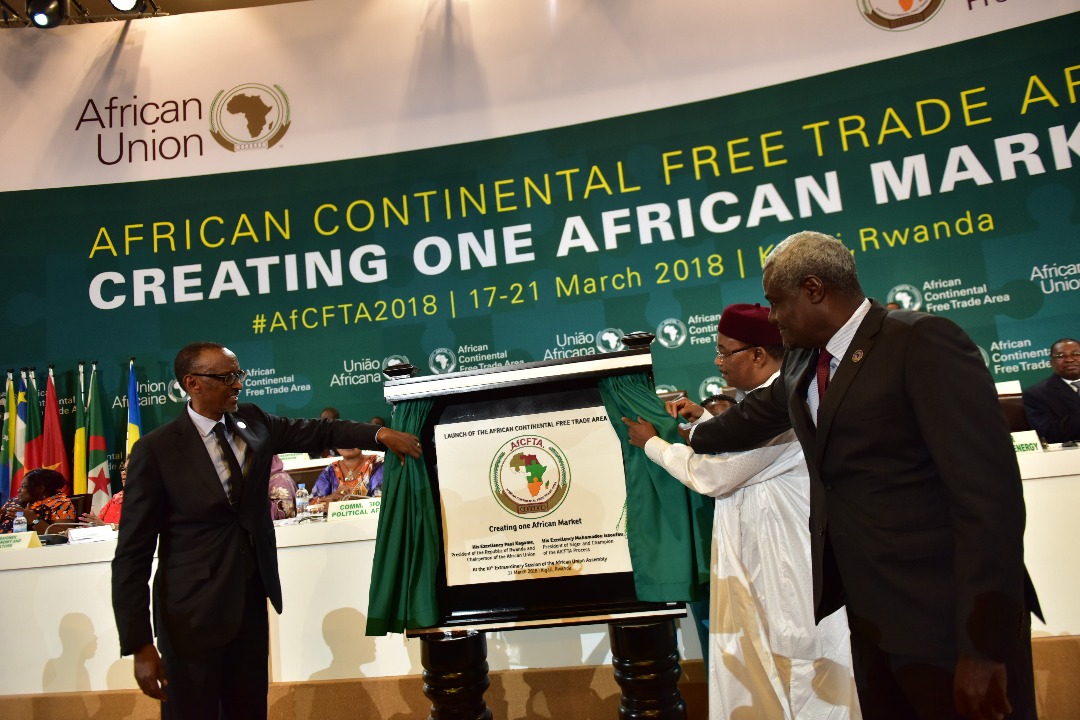
The African Continental Free Trade Area agreement was brokered by the African Union and signed on by 44 of its 55 member states in Kigali, Rwanda on March 21, 2018. Courtesy photo